
The Slow Work of God
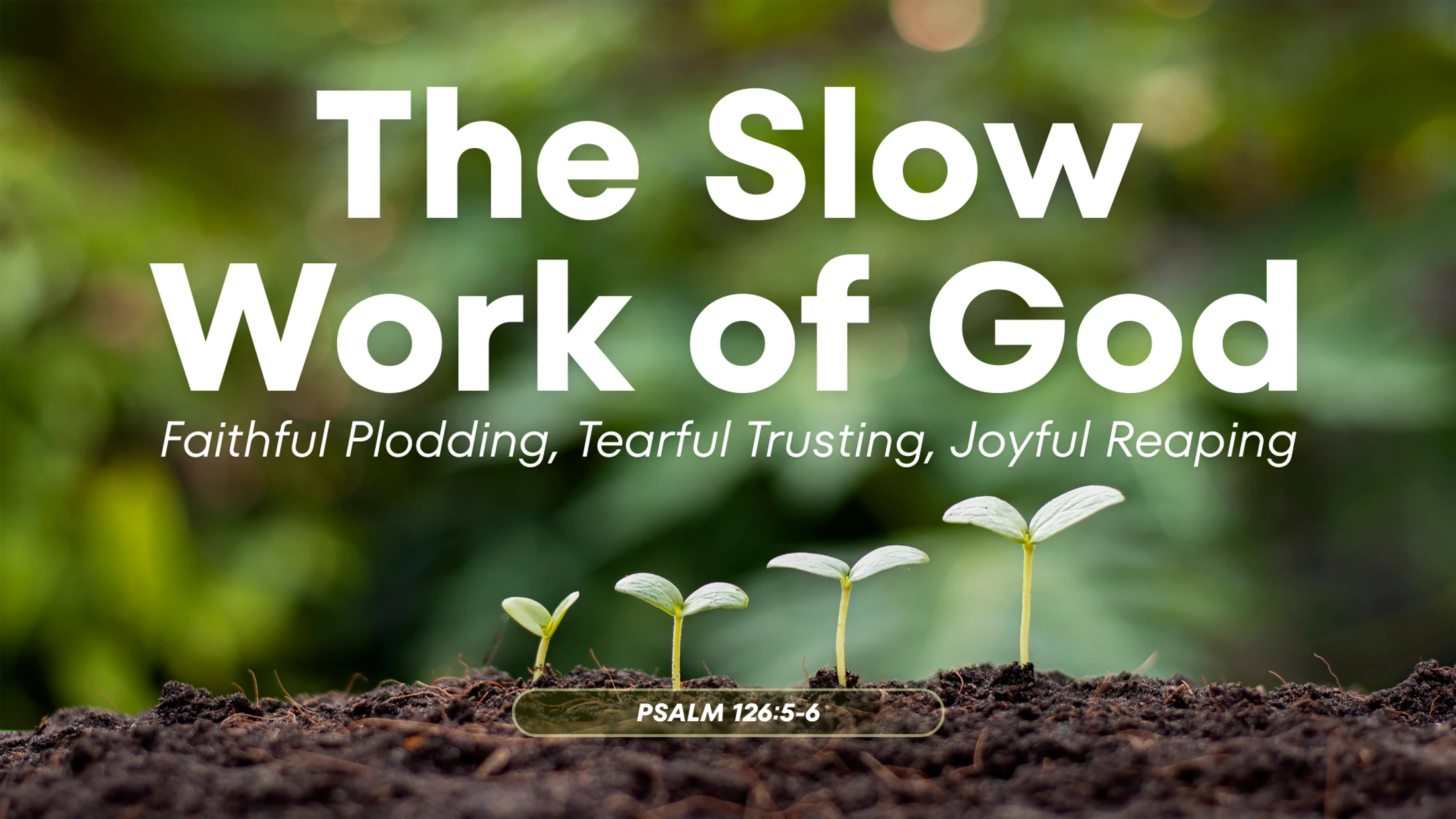
Faithful Plodding, Tearful Trust, Joyful Reaping
The Christian life isn’t a sprint. It’s more like a long walk through uneven terrain—step after step, day after day. Psalm 126 reminds us of that reality, especially in verses 5–6:
“Those who sow in tears shall reap with shouts of joy! He who goes out weeping, bearing the seed for sowing, shall come home with shouts of joy, bringing his sheaves with him.”
These verses give us a pattern for the journey of faith: faithful plodding, tearful trusting, and joyful reaping.
1. Faithful Plodding
The psalmist uses agricultural imagery that would have been second nature to his readers. In an ancient farming society, prosperity came through hard, ordinary work: plowing, sowing, watering, and waiting. No farmer could simply pray for a harvest while leaning on a shovel.
The picture is vivid: a farmer slings a bag of seed across his shoulder, walks row by row through the field, and scatters seed by hand. It’s repetitive, slow, and unseen work. But without that faithful plodding, there’s no harvest.
The same is true in the Christian life. Faith means action. We plod forward in the “in-between” by daily obedience: opening the Word, praying persistently, pursuing holiness, and bearing witness to Christ. Corporately, our churches plod by gathering consistently, serving sacrificially, and giving generously—even when revival feels far off.
Faithful plodding is not glamorous, but it is the way God brings fruit.
2. Tearful Trusting
Plodding isn’t just slow—it’s often painful. That’s why the psalmist connects sowing with tears.
Why tears? Because sowing required costly trust. The seed cast into the soil often came from the previous harvest’s food supply. Every handful of seed sown was food that could have been eaten. Planting was an act of faith, a declaration: “Lord, I trust You to provide a return.”
We sow with tears today when obedience feels costly. When serving drains us, when betrayal stings, when weariness settles in, we keep moving forward—not because we can handle it, but because we admit we can’t. Our tears are evidence that we’ve let go of self-sufficiency and placed our trust fully in God.
And here’s the beauty: those tears aren’t wasted. Just as water nourishes plants, the tears of the saints become the very means by which God brings life. F. B. Meyer once wrote, “It is not enough to sow; we must add passion, emotion, tender pity, strong cryings and tears.” God uses even our brokenness to water the seeds of faith.
3. Joyful Reaping
The psalm ends not with tears, but with joy. “Those who sow in tears shall reap with shouts of joy.” The harvest is not a “maybe”—it’s a promise.
The “sheaves” pictured here are bundles of collected grain. It’s the image of a farmer who left the field weeping but returns home rejoicing, arms full of the fruit of his labor. Paul echoes this in Galatians 6:9: “Let us not grow weary of doing good, for in due season we will reap, if we do not give up.”
This is the rhythm of the Christian life: sowing in obedience, waiting in dependence, and reaping in God’s perfect timing. For the church, it means we keep sowing the gospel, even in hard soil, with the confident anticipation that God will bring a harvest.
Conclusion
Faithful plodding, tearful trusting, joyful reaping—that’s not just the journey of Psalm 126. It’s the journey of every believer who follows Christ.
Our tears will not be wasted. Our plodding will not be in vain. Our God is faithful, and He promises that one day, we’ll come home rejoicing, bringing in the sheaves.
Reflection Questions
- Where in your life right now is God calling you to keep plodding faithfully, even when you can’t see immediate results?
- How might your tears of struggle or weariness actually be the very means God is using to water seeds for a future harvest?
This article was adapted from a recent sermon preached at CityLight Church.